
The past three months have felt like a year to many investors. Summer began with enthusiasm over the seemingly unstoppable Artificial Intelligence (AI) juggernaut and ended with a much more skeptical debate about costs, valuations, data centers, and the risks of artificial intelligence itself. The stock market has broadened and I tried to take advantage of this with small, non-tech additions, but so far tech is still the driver of performance. Despite prominent players like Dario Amodi (Anthropic) warning of an AI apocalypse, explosive sales growth does not seem to be slowing down, although stock prices marked time over the summer. If quarterly sales and earnings reports turn out to be as huge as some expect (reported in October), then many AI related companies are reasonably priced.
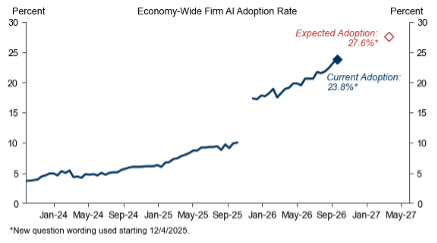
Sales at most AI related companies continue to grow rapidly. That distinction matters: a stock can become more attractive even while its price goes nowhere if earnings continue to rise. The following chart from Goldman Sachs shows steady growth in AI adoption by businesses, who are the most profitable customers for AI companies:
Hyperscalers such as Alphabet(GOOG), Amazon(AMZN), Meta(META) and Microsoft(MSFT), smell a once in a generation opportunity to grow explosive sales. But the race to build AI infrastructure requires enormous amounts of capital and reduces near-term free cash flow. This parallels the early development of other revolutionary technologies like the steam engine, the telegraph, telephone, the automobile, cable television, and internet fiberoptic cable. All began by consuming vast capital provided by adventurous investors who hoped to earn a fortune. I do not pretend to know exactly where the AI boom ends, but it is a near certainty that many of the promises of this technology will come to pass at a future date.[1] Some of today’s AI related businesses will win big (think of Amazon which grew out of the development of the internet). For me, it is worth staying involved with this industry, as part of a balanced portfolio while cautiously watching for signs of stress.
A big part of investing success is reading consumer and investor psychology. Greed is a powerful motivator. Usually after years of a bull market people become greedy and careless with portfolio allocation and stock selection. We will reach that point, but I’m not feeling it yet. For example, I do not hear the sort of indiscriminate enthusiasm today, that characterized the late stages of the Dot-Com bubble. When everyone from your college-age grandchild to your physical therapist is confidently discussing the profits to be made using leveraged call options, it may be time to worry. The bull market is likely not over, although selectivity is important.
Technology: Valuation Still Matters
<trclass=”table_lines”>Microsoft (MSFT)28.8×26.1xMore modest expected EPS growth
| Investment | Trailing P/E | Forward P/E | Observation |
| NVIDIA (NVDA) | 28.5x | 18.7x | Strong expected earnings growth |
| Broadcom (AVGO) | 45.0x | 20.4x | Large expected earnings increase |
| VanEck Semiconductor ETF (SMH) | ~34-45x | ~19-25x | Valuation varies by methodology |
Thinking back to the “.Com” Bubble, stocks like Cisco (CSCO) traded at Price-to-Earnings multiples of 85. Today, tech stocks like the well-known names above are not cheap but earnings are growing so rapidly that, with share prices moving sideways, earnings will “catch up” to make their prices reasonable.
“Show Me the Money”
I have long liked this line from the Tom Cruise movie Jerry Maguire because it captures one of my investment preferences: eventually, owners should see cash. Management can promise a bright future, reinvest in capacity and research, and compensate employees with generous stock options, but shareholders also deserve evidence that the enterprise is producing distributable value. Nvidia, for example, has used its considerable free cash flow to expand capacity, fund R&D and support strategic relationships. Its recent emphasis on returning more cash to shareholders reinforces a favorable view of the company. On September 28 company management announced a $150,000,000 share buyback authorization adding to an existing authorization of some $85,000. The figures are impressive but represent only a reduction of share count of about 5%. Still, it is reassuring to see real cash rather than promises coming our way. Further, there is evidence that management has been using buybacks to support share price when it sags in the same manner as Apple(AAPL) for over a decade.
Nvidia(NVDA), Broadcom(AVGO), Arista Networks(ANET), SK Hynix, Samsung, and Advanced Micro Devices(AMD) can be compared to hardware stores operating in Sacramento during California’s gold rush. Those who profited the most provided picks and shovels to gold miners, those who gambled it all, with only few winning. Today the “miners” are AI companies like Anthropic, Open AI, Cerebras and CoreWeave.
Who will find the Mother Lode? Recent earnings disclosures from Anthropic, parent of Claude AI, illustrate the extraordinary economics of the artificial intelligence build-out: rapidly expanding revenue accompanied by enormous operating losses as money is poured into training AI models.
Is Anthropic going to go bust? Will it be Open AI? The skeptics think the AI situation is a huge bubble with poor economics. However, I am in the camp that believes we are in the midst of a life changing technological revolution and one worthy of investment. Why? Almost everyone I talk to is using AI. Baby Boomers, Millennials and Gen Z are all adopting it. Further, as the chart above indicates, adoption by corporate America is rapid but with room for much greater growth. Capital investment by AI developers is expected to be over 1.2 $ Trillion globally in 2027. As with other revolutionary technologies of the past, AI is set to become embedded in society and there will be companies who enjoy a strong stream of profits, eventually. We have our largest bet with the companies that provide picks and shovels.
Headwind from Bonds
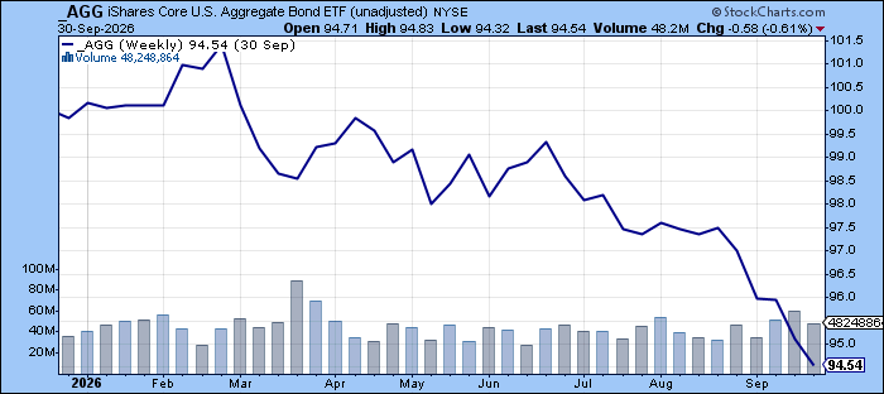
Some years ago, I used Bette Midler’s song “Wind Beneath My Wings” as a metaphor for fixed income. For decades, falling interest rates increased the value of older, higher-coupon bonds and preferred stocks and added to total returns on balanced portfolios for clients. That tailwind has changed direction. Bond and preferred-stock prices have been under pressure, because in a period of rising interest rates for newly issued bonds, previously issued bonds with less attractive coupons, are market down in the secondary market. When held to maturity, these older issues will return every penny invested, but they do weigh on reported portfolio values until they mature.
To see how fixed income prices have hurt performance this year, below is a chart of a widely followed bond index that includes both government and corporate bonds:
Source Stockcharts.com
The US Federal government has issued about $21.8 trillion of bills, bonds, and notes year to date, up about 12% from the volume of 2025, while foreign demand for the enormous supply of U.S. Treasury debt has weakened. This is not just a USA problem. There appears to be no nation able to control its spending. When excess money is created this drives inflation and this year, inflation is exacerbated by conflict in the Middle East that has driven energy prices to historic highs. Rising interest rates are a global phenomenon, and it appears to have room to run.
I have responded to the situation by reducing some very long-maturity preferred stock positions when their yields no longer justify the interest-rate risk. Still, many clients own high-quality fixed-income securities yielding above 5%, and some above 6% and they continue paying us to hold them. At maturity, every dollar invested will be returned. Never the less, sagging valuations for preferreds and bonds has constrained client performance so far this year.
Traditionally, balanced portfolios allocate about 40% to fixed income and 60% to equities. When I feel yields on quality bonds are near a peak, you’ll probably see some of these better yielding instruments added to the mix but for now, most clients are collecting about 3.7% on purchased money market funds, without the risk of penalties that characterize certificates of deposit so that we can quickly apply this “cash” to better opportunities as they arise.
A Stock Market That Deserves Respect – and Caution
Consider the broad US stock market. An important technical indicator is the number of S&P 500 stocks trading above their 200-day moving average (see chart below). It is a slow indicator, which is precisely why I pay attention when it turns. In August, the reading was bullish with 375 out of the S&P 500 stocks in a bull trend. By quarter-end, the number weakened sharply.
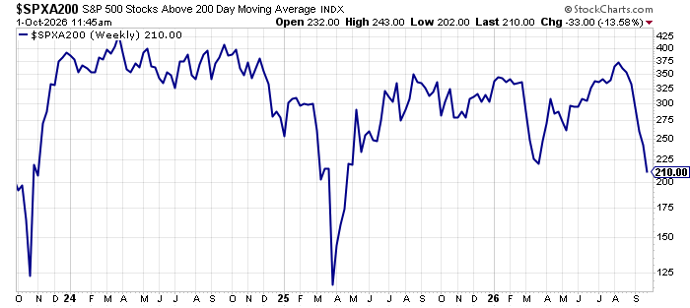
This was in reaction to the sharp rise for interest rates. A popular way to value stocks, taught in most business schools, is the Discount Model. Using reported earnings or free cash flow (EBITDA) an analyst projects growth some years into the future, then adjusts this back down to today’s dollars. The discounting mechanism employed to “discount to present value” is usually the yield on ten year T-Bonds along with a factor called the “Equity Risk Premium.” In recent weeks, the 10 year bond yield has busted into levels unseen in over a generation, so the discounted present value of stocks has tumbled. Yet the economy, at least in the USA, seems to be humming along. Is it possible that math is wrong?
Economic data are also sending mixed signals. Business activity and manufacturing have shown strength, supported by consumer spending, capital investment, and defense outlays. At the same time, mortgage rates have risen above 7%, an obvious restraint on housing and other rate-sensitive parts of the economy, like auto sales.
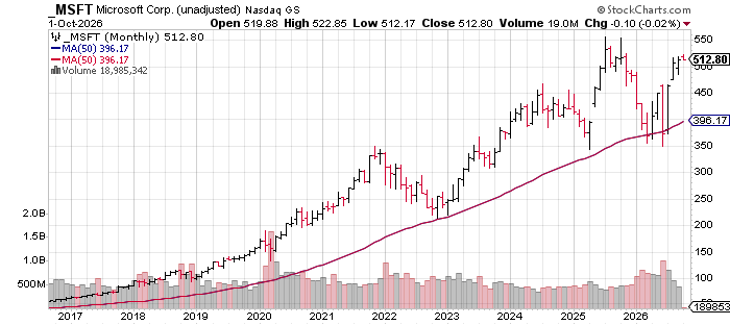
To me, the current situation argues for caution, not panic. Our core portfolios have held up reasonably well and are up for the year. Successful investing benefits from approaching the process as a long-term project. Microsoft (MSFT) is a good example: we have owned it for more than a decade, adjusting the position size along the way. Look how the stock has had 30% corrections multiple times in the past 10 years, yet Microsoft has been an excellent long term holding.
Debt, Gold, and Real Assets
Federal deficits are of concern. When I began my career in 1974, people were wringing their hands over government debt. Many people decided to buy gold and silver as they felt traditional monetary metals would retain value as the buying power of paper currency declined. I’ve been astonished and impressed to observe, for over half a century, how America has managed to grow its Gross Domestic Product rapidly enough to assuage worries about deficits. That history deserves respect. But it does not make unlimited borrowing harmless, particularly when higher interest costs begin competing with other government priorities. Today the interest on Federal debt is greater than our spending for defense. Without sharply curtailed spending or a new source of revenue (taxes or tariffs) it’s hard to see a happy result ahead. There is a crowding out effect on private borrowing which has to compete with the government for investor dollars, usually by offering high interest rates. We see it right now. Young families suddenly cannot afford to buy a home due to high mortgage rates. High yields on CD’s and bonds are just great for retirees, but damaging to others.
It is to be noted that a number of nations, France and the Netherlands among them, have removed gold they were storing in the United States. China is using its considerable trade surplus to add to its gold reserves. Gold is not a perfect alternative to holding “paper” dollars, but one of many useful ways to hedge risk, in my opinion.
We maintain some exposure to gold through an exchange-traded fund, SPDR Gold Shares (GLD). Likewise, the First Eagle funds and ETF’s in many client portfolios are unique in that they hold a meaningful allocation to gold. Another hedge against a weakening dollar is energy related holdings.

Where We Stand
My approach remains the same as it has always been: own good businesses, insist on reasonable valuations, collect income where it is available, diversify intelligently and avoid emotional decisions. Markets will continue to give us reasons to worry but that “Wall of Worry” is often what keeps a bull market from becoming a true bubble. My most important job is to avoid or at least minimize erosion of your portfolio. I try to never forget this.
Gary E Miller, CFP™
[1] We must acknowledge the worries about AI that have recently become prominent. Yet does anyone believe that one of many global government regulators will slow or stop this technological growth?
