
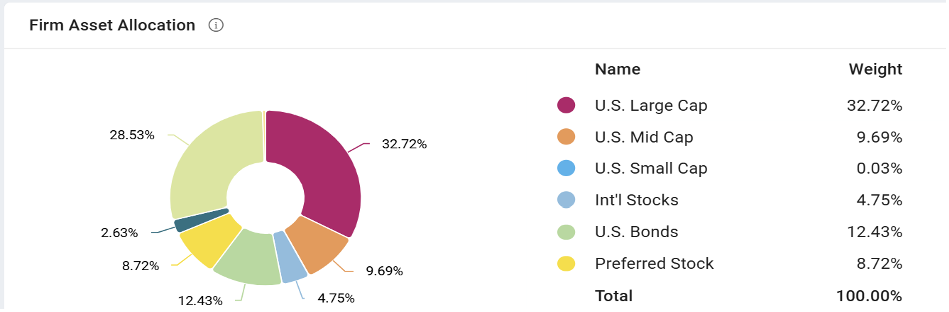
For most clients, it was a tepid quarter, up single digits driven mostly by dividends and interest. When averaged over the past 12 months, high single digit returns were enjoyed by many clients, but performance cannot be generalized. Each client is unique. My practice is what is sometimes referred to as a “boutique” practice. Name a client and I know quite a bit about his, her or their situation, especially about risk tolerance and the need for income. No two portfolios are identical. The graphic below, however, is a pretty good representation of our asset class allocation and how clients are generally allocated:
We saw nice performance from Coca Cola, Dominion Resources and Parnassus fund. Apple sagged but is now recovering nicely. Let’s take a look at various market sectors:
US Common Stocks: Indexes saw broadening participation. There was some profit taking in technology, a healthy sign. Banking stocks did well despite a turn in sentiment to a belief that interest rates will not be pushed lower by the Federal Reserve. Deregulation, for which banks have lobbied for over a decade is happening. I believe looser policing of regulated banks will eventually lead to another financial crisis, but for now investors are buying the banks because watered down Tier I capital rules free up bank capital for… more and riskier loans (along with the fees these generate). Energy company shares soared, after a US/Israeli foray into the hornets nest known as Iran. At quarter end, a fragile cease fire saw oil prices tumble, along with prices for the Majors. For the moment a cease fire seems to suit both the Iranians and the US Administration which is hoping to sooth voters’ annoyance at high gasoline prices. Meanwhile, technology, especially stocks related to artificial intelligence, has become a confusing cross current of opinions. Everyone seems to agree that AI will make businesses more productive, accelerate development of cures and improve everyday life for humanity[1]. No one seems to agree how profits will flow to reward the huge level of capital investment required from “hyperscalers” like Meta, Amazon, Microsoft, Google, and Oracle. Free cash flow for stock buybacks and dividend increases is being diverted to invest in AI data centers, including land, chips, systems, electricity, personnel and legal costs. This led to flat or sagging performance for most of the tech giants.
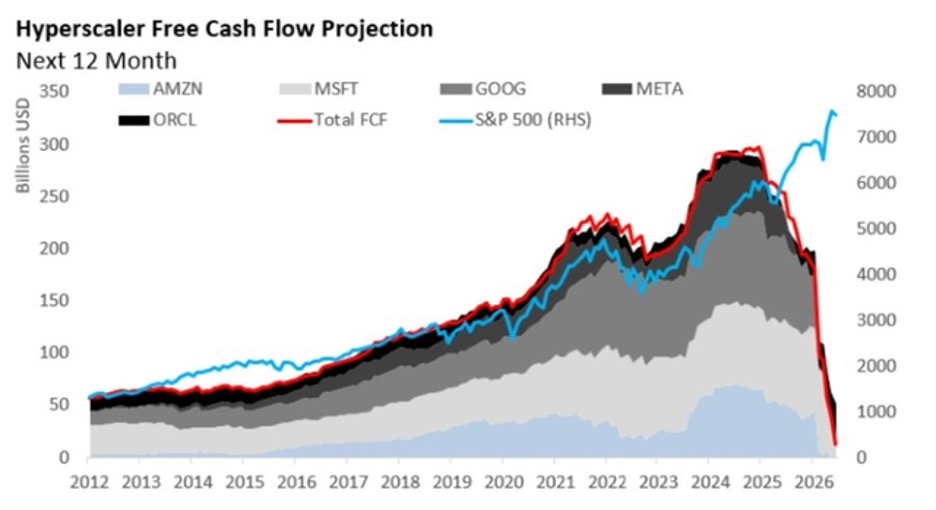
I felt it prudent to reduce exposure to Microsoft, a company that we began owning ten years ago and with, for most clients, a large, unrealized profit. In contrast, Industries providing the “picks and shovels”, companies like Nvidia, Micron Technology, Intel, SK Hynix, Broadcom to name a few, have done very well this year but have also seen extreme share volatility.
The year began with investors viewing artificial intelligence as a limitless opportunity for profit, but by mid year, some doubters are suggesting that competing AI platforms such as Anthropic, ChatGPT CoPilot, Grok and Gemini are interchangeable. None are really earning a profit as they have free versions and subscription pricing is pretty low. They are hoping to develop recurring subscription revenue, like Netflix does with streaming video. But with the possible exception of Claude, which appeals to coders, it’s hard to tell which of these will distinguish itself to become a profitable business.
Fixed Income: From a January belief that interest rates would fall, to a mid-year belief that they will rise, investment grade bonds generally fell in market value. Fear of rising rates put pressure on long dated preferred stocks, too. A year ago, then Fed Chairman Powell cited a goal of 2.00% inflation. Today, no one, including the new Fed chief Kevin Warsh is mentioning that possibility. If inflation does not cool off, short term rates could be increased so fixed income and dividend stocks are vulnerable.
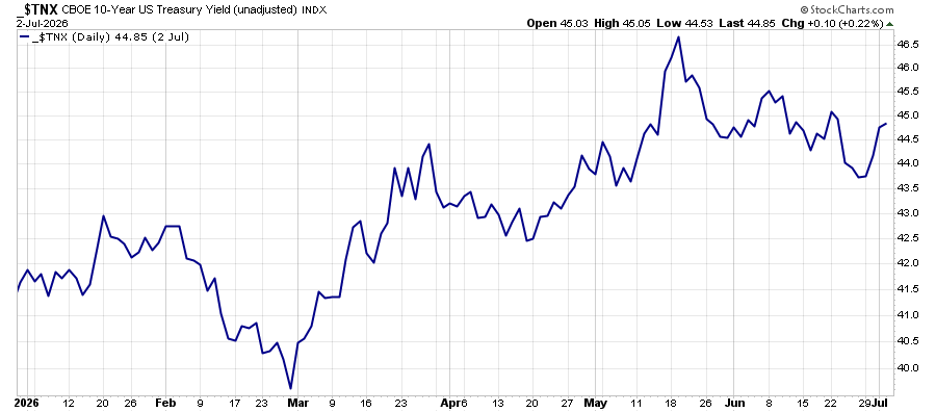
Interest rates (here the 10 year Treasury Bond is shown) rose
Private Market Equity: I have not engaged in this channel because thirty years ago I learned the pain of being locked into a non publicly traded investment (oil and gas partnerships). A newer generation of investment advisors appear to have added private equity to client holdings, partnerships owning commercial real estate, or start up small businesses. Now it seems the tide is going out for this type of equity. Poor liquidity has a lot of people feeling trapped, because they cannot sell. Shrinking asset values, especially in commercial real estate, mean that private equity sponsors like Blue Owl or Blackrock are unable to meet demands for liquidation from their clients. Multiple hedge fund managers have refused to allow their investors to access their money, or have “gated”, that is, limited the dollars that can be withdrawn.[2] This is not your problem dear client, but there is an underlying concern about how exposed large banks or even insurance companies are as they may have loaned money to fund sponsors.
Real Estate– it appears the hot residential markets of the South and Southwest have cooled[3]. With mortgage costs stuck in the mid-6% range plus associated costs of home ownership soaring,[4] the hoped-for recovery has not materialized. Young Gen-Zers have in many cases abandoned the American Dream of home ownership. Meanwhile, large numbers of homes have been gobbled up by investment partnerships (such as private equity) with deep pockets. At quarter end, bi-partisan Federal legislation to encourage more home building, the ROAD to Housing Act, was aborted as the President demanded Federal voter registration be addressed first (SAVE act).
Gold and Precious Metals Sagged. Rising interest rates were cited because carrying costs for storage and futures contracts follow rising interest rates. Further, new Fed Chair Kevin Warsh is being given a holiday from President Trump’s pressure to lower rates (Gold Bugs feel lowering rates is irresponsible). After last year’s historic run-up for gold and other precious metals, it seems buyer interest is seeking other avenues. Given my belief that insurmountable government deficits will result in high embedded inflation, and relentless weakening of the US dollar’s buying power, the currently modest allocation held in client portfolios remains an appropriate inflation hedge for you.
Politics: wins by socialists in recent Democrat primaries nationwide will worry markets if, in the November general election, the GOP loses its majority. Congressional hearings could take on an anti-business tone and will no doubt include proposals to roll back capital gain tax exclusions, raise estate taxes, punish “excessive profits” and attack Wall Street. While it is unlikely that such proposals will get far and would not be signed by the president, headlines could unnerve investors.
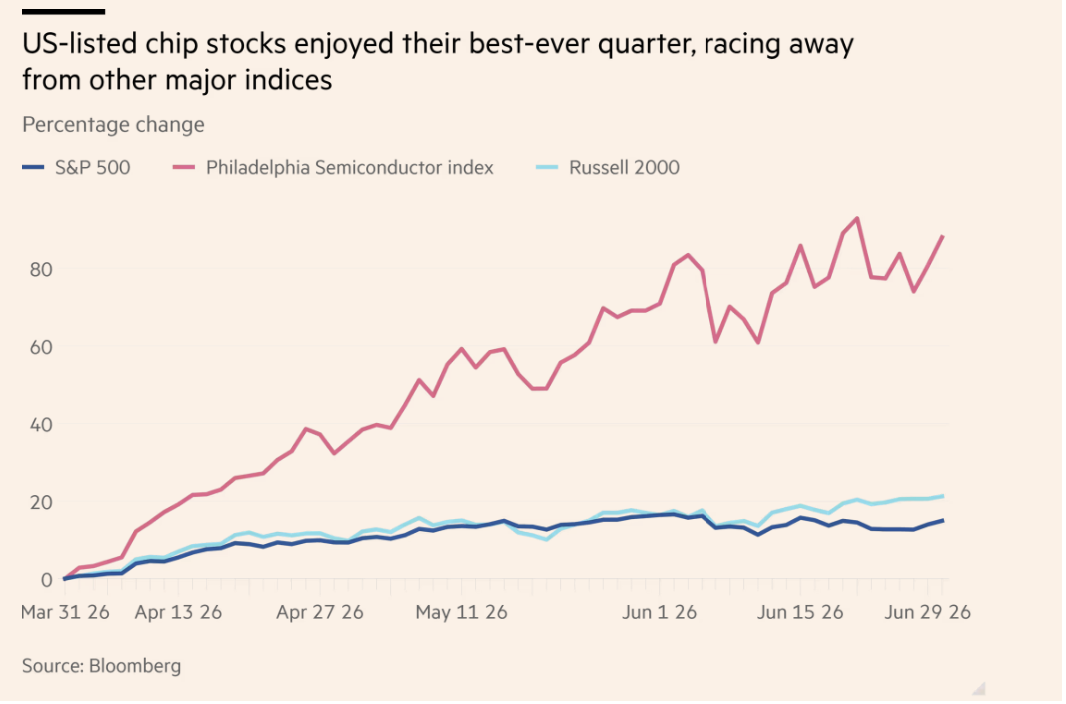
One Clear Winner: Semi Conductors
Most clients own semi conductors directly through stocks such as Nvida (NVDA) or the Van Eck Semi Conductor Exchange Traded Fund (SMH). Nvidia remains a favorite of analysts and professional money managers, and is one of mine. It rose 10.5% in the quarter, 7.4% year-to -date. In normal times this would be an impressive rate of return. But its performance was dwarfed by other semi conductors: the Van Eck semiconductor index fund, for example, has risen 82% for the year of which 71% was seen last quarter alone! Names like Micron, ARM, SK Hynix and Intel flew heavenward as the markets began to appreciate that high bandwidth CPU’s (Central Processing Units) have become just as important as Nvidia’s GPUs (Graphic Processing Units) to process large language models.
Lack of Conviction
Listening to talking heads on financial channels (CNBC’s “Fast Money” is one of my favorites), there is little conviction. No one seems to have a clear reason why any one sector or industry should perform better than another. Since I share this mystification, and because some long term winners, like Microsoft (MSFT) were sagging, I raised cash, awaiting clearer indications of where to place your funds.
Where did your profits go? They are not sitting idly in cash. “Purchased” or overnight money market funds are paying 3.25%, and unlike a CD, the money is not locked up or subject to penalty for early withdrawal. With this in mind, a larger than usual allocation was, at quarter end, devoted to this holding. Short term, liquid income producing cash may not be a long term strategy, but is a legitimate tool for risk management. The Summer can be a dangerous time. While the gaze of many people is directed toward children playing on the beach or investors are napping in the sun, Bear Raids are not uncommon in thinly traded markets. While awaiting technical indications that would encourage redeployment of cash, I’m feeling cautious for the next few weeks.
More about Nvidia
Nvidia (NVDA) held directly or via mutual funds, is nowhere close to bubble valuation. Current excitement around semiconductors has led to comparisons with the “.Com” bubble of the late 1990’s. In early 2001, I recall analyzing Cisco Systems (CSCO). It traded at something like 85 times earnings (AKA a Price to Earnings Ratio of 85). For this reason, I decided it was too expensive to buy. Today, Nvidia trades at a PE of about 25. While not cheap, this is not bubble territory. Witness the growth for Nvidia’s net operating income:
NVIDIA (NVDA) — GAAP Operating Income Growth
| Measurement Period | Operating Income Comparison | Growth Rate |
| Past 3 Months — Sequential | $53.536 billion vs. $44.299 billion | +21% |
| Past 12 Months — Year over Year | $53.536 billion vs. $21.638 billion | +147% |
| Past 3 Years — Compound Annual Growth Rate | $53.536 billion vs. $2.140 billion | +192% CAGR |
Many financial analysts argue that Nvdia should be trading at a price earnings ratio of at least 30.
Outlook and Summary
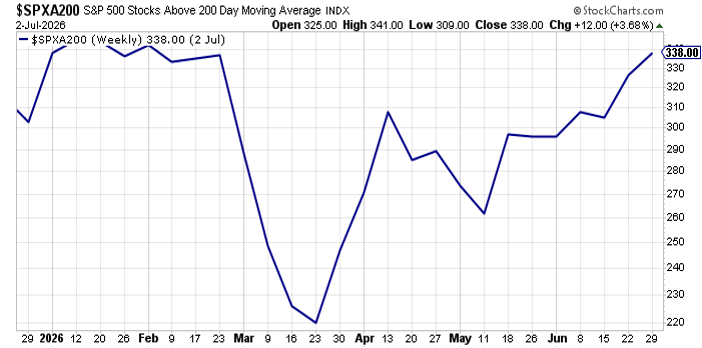
New stock market highs have been achieved and there has been a broadening of bullish trending participants. Of the 500 stocks composing the S&P 500 index, some 320 are trading above their 200 day moving average. Bonds and preferred stocks are struggling as secondary market prices have sagged with interest rates trending higher. I’m inclined to introduce broader exposure to non-technology holdings in coming weeks, but as mentioned, given seasonal vulnerabilities, I’m not rushing to buy anything.
As always, I am interested in hearing your views, and certainly of any changes in your outlook, objectives, health, and cash flow needs.
Thanks for allowing us to be of service!
Gary Miller
[1] Actually, there is a significant body of worry that AI is going to become or may already be a threat to humanity.
[2] https://www.wsj.com/finance/investing/investors-seek-to-pull-nearly-16-billion-from-private-credit-funds-81b6fe37?mod=Searchresults&pos=10&page=1 NOTE Your investments with Trusted Financial are all publicly traded, and hence liquid
[3] https://fortune.com/2026/04/21/housing-market-winners-vs-losers-florida-texas-ohio/
[4] https://www.wsj.com/economy/housing/home-ownership-costs-charts-7fe04eb3
