
November 13, 2026
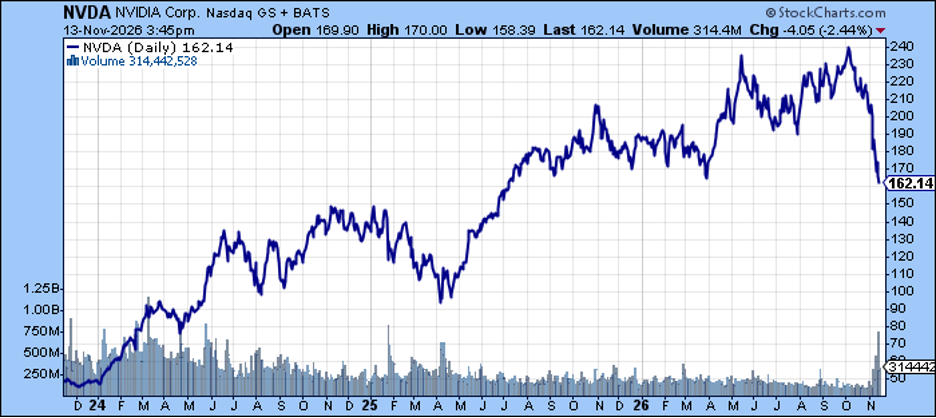
Only a couple of weeks ago, when the chip market corrected, I pointed out that large swings are normal for this industry. Some of our longest and most successful holdings have repeatedly had corrections of 25% to 30% within a single calendar year yet returned to their long-term growth rates. Nvidia had already given back some ground from its recent peak, prior to the shocking events of the past week, and remained holding worth keeping through that pullback.
Then, last weekend, The New York Times exposed unacceptable personal conduct by Nvidia’s chief executive, Jensen Huang, the face of Nvidia. Subsequent reports of inappropriate relationships, including one with an executive who reported to him, made his poor judgment plain. Mr. Huang resigned on November 12, and the board named Chief Financial Officer Colette Kress as interim CEO.
The Nvidia story has become an opportunity for nearly everyone in America to have an opinion, and for politicians to grandstand. As of this writing, I have chosen to substantially maintain your holding in the stock. I did trim positions in some taxable accounts where I had made purchases this summer, since that created an opportunity for tax-loss harvesting.
Why I prefer to hold:
- Your position is a modest part of your portfolio. Your Nvidia holding currently represents about 4% to 5% of your total portfolio. Before the selloff, many clients’ allocations were between 6% and 7%. Even a further severe decline in the share price would have a relatively small effect on your overall portfolio.
- Nvidia is far more than its CEO. It is a collection of highly trained, highly specialized engineers and design teams, service, and marketing specialists, with some 40,000 employees.
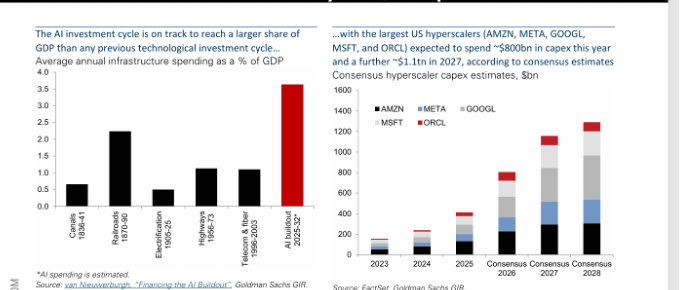
- Competition is expected, but it is very difficult to replicate and replace Nvidia’s Graphics Processing Unites (GPU) and demand is growing fast. Cathie Wood, a respected technology investor, points out that Nvidia was always expected to lose some market share to competitors, as customers are seeking alternatives and workarounds. Yet the demand for chip sets, which include both GPU’s and CPU’s, is growing exponentially. Its current share is about 83% of the market. Even if that were cut in half, the company would still be growing at a compounding rate of about 25% a year. Here are two charts from an analytical report sent to me by Goldman Sachs research. The chat on the right shows how rapidly planned spending is rising. The one to the left is more remarkable. It shows that expected spending on artificial intelligence as a percentage of US gross domestic product is greater than major past industrial and technological revolutions of the past.
- Nvidia’s chips and its software are very hard to replace. Nvidia’s graphics processing units (GPUs) are far from a commodity. It is generally agreed that no other company comes close to producing such an efficient chip, although others are certainly trying. There is more to the story, too: software unique to Nvidia GPUs, known as CUDA. Customers that build data centers around Nvidia GPUs must also adopt a suite of tools built on CUDA, and at this point there is no real competitor. As the Eagles’ song
Hotel California
, said “you can check in any time you want but you can never leave.” Once a company builds a data center around Nvidia chips, the cost to switch is prohibitive.
- Demand for Nvidia’s Blackwell and Vera Rubin chips is huge and nearly insatiable. In addition to demand from hyperscale companies like Microsoft, Oracle, Meta, and Amazon, we have clear evidence that China will used every trick in its bag to obtain these powerful processors.
- The order backlog is extensive. It is generally believed that Nvidia has solid contracts to deliver chips for the next three to five years.
- Experienced leadership is in place for now. I tend to agree with analysts who say that the choice of a permanent CEO will be crucial to maintaining and expanding sales, and that choice is an unknown. In the meantime, Chief Financial Officer Colette Kress has become interim CEO and is highly experienced. She has been with the company for 13 years and previously worked at other well-known technology firms, Microsoft, Cisco, and Texas Instruments. She is said to be more conservative than Mr. Huang, and many believe that is a good thing because Nvidia has been promising to back and finance a wide range of other Silicon Valley companies, many of them currently unprofitable. Indications are she was not enthusiastic about these ventures and more inclined to stick to the knitting of developing ever more efficient GPU’s.
- The early trading action is encouraging. After the announcement that Mr. Huang was leaving, the stock fell sharply at the open but recovered to close down by less than 5% for the day. Volume was very high, which suggests there are still significant institutional buyers.
- Increased share buybacks and dividend payouts may be in the offing as new management seeks to reassure current shareholders. This was the pattern at Apple (AAPL) after Steve Jobs passed away. Tim Cook, who replaced Jobs, significantly increased payouts to shareholders. As my clients know, I prefer companies to share the wealth with my clients.
- The stock is cheap By any measure, Nvidia is an inexpensive stock. Here are price earnings ratios for competitors:
| Company Name | Ticker | Current P/E Ratio (Trailing) | Projected P/E Ratio (Forward) |
| Nvidia Corporation | NASDAQ: NVDA | 21.9x | 12.0x |
| Broadcom Inc. | NASDAQ: AVGO | 42.8x | 20.1x |
| Taiwan Semiconductor Manufacturing | NYSE: TSM | 31.0x | 24.5x |
| Advanced Micro Devices | NASDAQ: AMD | 118.7x | 33.5x |
| Qualcomm Inc. | NASDAQ: QCOM | 13.8x | 11.5x |
Where this leaves us
For many clients, we initiated a position in Nvidia in early 2024, and even after this selloff the stock has been up well over 300% since then. I added to the position, or brought in some new clients this summer, and those positions are generally underwater, but the drawdown is not insurmountable.
So, at this moment, it is my intention to hold your current position, although you are of course welcome to instruct me to sell if that would give you greater peace of mind.
There may be more shoes to drop, particularly around national security issues raised regarding Chinese influence on Nvidia product sales. We can also expect a good deal of noise from the new Congress, including threats to rein in, punish or even nationalize the company. Volatility will continue. In the end, though, I don’t believe the phenomenal momentum, the monumental growth in artificial intelligence, and the demand for the computing power that drives the growth of data centers and AI technology is going to stop although it could slow down.
Three of our longest holdings, Enterprise Product Partners (EPD), Microsoft (MSFT), and Apple (AAPL) all saw major price draw downs, more than once, in the years they’ve been held in your portfolio, and all have been unqualified winners over a longer period of time. I believe the same will prove true for Nvidia.
Gary E. Miller, CFP
